High Mast Lights
High Mast Lights are powerful, elevated lighting systems designed to provide wide-area illumination across large outdoor spaces. Mounted on tall poles ranging from 12 meters to 40 meters in height, these lights are commonly used in highways, industrial zones, stadiums, ports, airports, railway yards, toll plazas, and large public areas where uniform, high-intensity lighting is required. Their height, design efficiency, and superior luminosity make High Mast lighting one of the most reliable solutions for modern infrastructure.
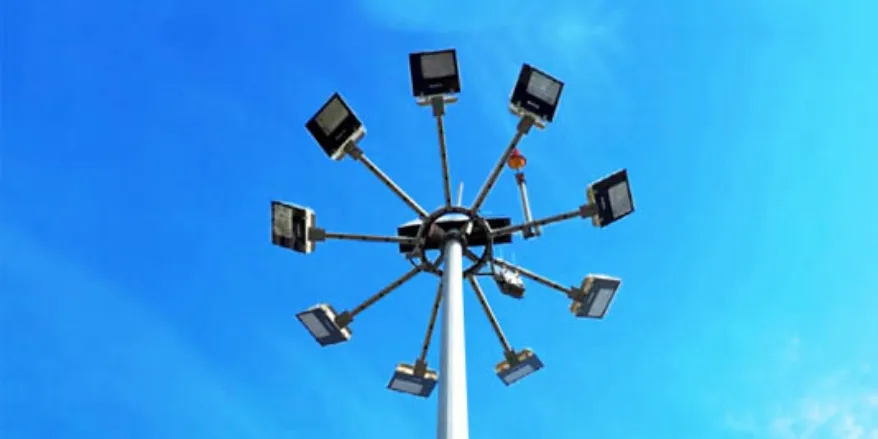
A standard High Mast Light system consists of a high-strength galvanized pole, a lighting ring (fixed or motorized), LED floodlights, control gear boxes, lowering and raising mechanisms, and safety features. The floodlights are strategically angled to distribute light evenly over a large radius without creating glare or dark spots. Modern LED High Mast Lights offer long lifespan, high energy efficiency, and consistent brightness, significantly reducing power consumption and maintenance costs.
One of the major advantages of High Mast Lights is their ability to illuminate a vast area using fewer poles. Compared to conventional street lighting, high mast systems require less installation space and wiring. This makes them ideal for highways, busy intersections, large sites, and commercial spaces where ground-level installation is challenging. The motorized high mast variants are equipped with a winch mechanism that allows technicians to safely lower the lighting ring to ground level for maintenance, eliminating the need for cranes or elevated platforms.
High Mast Lights are engineered to withstand harsh weather conditions, including heavy winds, rain, dust, and extreme temperatures. The poles are typically constructed using hot dip galvanized steel with a long-lasting anti-rust coating. The LED luminaires come with IP65/IP66 protection, ensuring durability and performance throughout the year. These lights are also available in different wattages ranging from 100W to 1500W, depending on the required lighting coverage and lux level.
In recent years, LED technology has revolutionized the high mast lighting industry. LED High Mast Lights consume far less energy compared to conventional sodium or metal halide lamps while providing brighter and more focused illumination. They offer instant start-up, minimal heat generation, and long operational life of up to 50,000 hours or more. Their low maintenance and operational efficiency make them an ideal choice for modern lighting applications.
High Mast Lights also contribute significantly to safety and security. Well-lit highways reduce the risk of accidents, while illuminated industrial zones ensure safer nighttime operations. Ports, stadiums, and parking areas benefit greatly from the increased visibility that high mast lighting provides. The uniform illumination prevents shadows, improving surveillance and reducing the risk of theft, accidents, and criminal activities.
These lighting systems can be equipped with smart features such as automatic timers, dimming options, motion sensors, and IoT-based remote monitoring. This allows operators to control lighting levels, reduce energy wastage, and monitor performance from a centralized system. Smart high mast lighting is increasingly being adopted in smart city projects and urban infrastructure development.
Environmentally, High Mast LED Lights offer a cleaner and greener solution by reducing carbon emissions, energy consumption, and light pollution. Their excellent optical control ensures targeted lighting, reducing light spillover and promoting eco-friendly city planning.
In summary, High Mast Lights are a dependable, efficient, and advanced lighting solution for large-scale outdoor illumination. Their robust design, high performance, long lifespan, energy savings, and safety benefits make them essential for highways, industrial areas, sports complexes, transportation hubs, and modern infrastructure. As technology evolves, LED and smart high mast lighting continue to set new standards in outdoor lighting performance and sustainability.